
Making the decision to try sedation dentistry is one thing. Actually understanding what will happen before, during, and after your sedated appointment is another. For many patients at Holladay Dental Studio, knowing exactly what to expect transforms anxiety into confidence.
This comprehensive guide walks you through every phase of the sedation dentistry experience. Whether you’re considering nitrous oxide, oral sedation, or IV sedation, you’ll learn precisely what happens at each step, how to prepare, and what your recovery will look like.
Before Your Sedation Appointment: Preparation Is Key
The foundation for a successful sedation dentistry experience begins well before you arrive at the dental office. Proper preparation ensures both your safety and comfort throughout the process.
The Pre-Sedation Consultation
Your journey typically starts with a consultation at Holladay Dental Studio. During this meeting, Dr. Andrew Ericksen will:
Review your complete medical history, including any chronic conditions, past surgeries, allergies, and current health status. This information helps determine which sedation option is safest and most appropriate for you.
Discuss all medications and supplements you currently take. Some medications interact with sedation drugs, and you may need to temporarily adjust your regimen before your sedated appointment.
Evaluate your anxiety level and discuss previous experiences with dental care or sedation. Understanding what triggers your anxiety helps the team provide better support.
Explain the dental procedures you need and recommend an appropriate sedation level. The complexity and duration of your treatment influence which sedation option makes the most sense.
Address your questions and concerns. This is your opportunity to ask about anything that worries you, from how the sedation will feel to what happens if you need to use the restroom during a long procedure.
Understanding Pre-Appointment Instructions
Once you’ve scheduled a sedated appointment, you’ll receive specific pre-procedure instructions. These vary based on the type of sedation you’ve chosen, but certain guidelines apply across all sedation types.
For nitrous oxide sedation, preparation is minimal. You can eat normally before your appointment since nitrous oxide doesn’t typically cause nausea. Wear comfortable clothing and remove contact lenses if you prefer glasses. That’s about it.
For oral sedation, you’ll need to follow more detailed instructions:
Take your prescribed sedation medication exactly as directed, typically about one hour before your scheduled appointment time. Don’t take it too early or too late, as timing affects how well it works.
Arrange transportation before your appointment day. You absolutely cannot drive yourself. Have a responsible adult ready to drive you to Holladay Dental Studio, wait during your procedure or remain available to pick you up, and stay with you for several hours after you return home.
Follow any fasting guidelines provided. Some dentists recommend avoiding heavy meals for a few hours before taking your medication to prevent nausea, though requirements vary.
Avoid alcohol for at least 24 hours before your appointment. Alcohol and sedation medications interact dangerously.
Wear loose, comfortable clothing with short sleeves (in case monitoring equipment needs to be attached to your arm).
For IV sedation, preparation is most extensive:
Fasting is typically required. You’ll usually need to avoid food for 6-8 hours before your procedure and stop clear liquids 2-4 hours beforehand. Specific instructions will be provided based on your appointment time.
Arrange for someone to accompany you to your appointment, wait during your procedure, drive you home, and stay with you for the rest of the day. This person should be a responsible adult who can assist you if needed.
Wear comfortable, loose-fitting clothing with sleeves that can be easily rolled up for IV placement and blood pressure monitoring.
Remove all jewelry, especially rings that might interfere with monitoring equipment on your hands or fingers.
Leave valuables at home and bring only essential items.
If you wear contact lenses, remove them before your appointment or bring glasses to wear instead.
Take any regular medications as instructed. Some medications should be taken as usual on the morning of your procedure, while others should be skipped. Dr. Ericksen will provide clear guidance about each of your medications.
The Night Before Your Appointment
Getting adequate rest the night before your sedated appointment helps ensure your body is in the best condition for sedation. Try to:
Go to bed at a reasonable hour to get a full night’s sleep. Being overtired can affect how you respond to sedation.
Avoid alcohol completely, as it can interact with sedation medications even hours later.
Pack any items you’ll need the day of your procedure: your insurance card, a list of medications you take, comfortable shoes you can easily slip on, and sunglasses (your eyes may be sensitive to light after sedation).
Confirm your transportation arrangements one final time.
Set multiple alarms if you need to take oral sedation medication at a specific time.
Arrival at Holladay Dental Studio: Getting Started
The morning of your sedation appointment, you’ll arrive at Holladay Dental Studio accompanied by your driver (if having oral or IV sedation). The friendly staff will welcome you and get you checked in.
Check-In Process
Upon arrival, you’ll complete any remaining paperwork. If you’ve already taken oral sedation medication at home, staff will note what time you took it and how you’re feeling.
The team will verify your pre-procedure instructions were followed. This isn’t about catching you breaking rules but about ensuring your safety. If you accidentally ate breakfast before an IV sedation appointment, for example, the procedure might need to be rescheduled rather than risk complications.
Moving to the Treatment Area
Once checked in, you’ll be escorted to the operatory (treatment room) where your procedure will take place. At Holladay Dental Studio, each operatory is designed with patient comfort in mind, featuring:
Massage chairs that provide gentle vibration and warmth to help you relax even before sedation begins.
Televisions mounted where you can see them from the dental chair, offering distraction and entertainment.
Blankets and pillows available if you’d like extra physical comfort.
The friendly dental team will help you get settled, adjust the chair to a comfortable position, and make sure you have everything you need.
During Sedation Administration: Each Method Explained
How sedation is administered and what you’ll experience varies significantly based on the type you’ve chosen.
Nitrous Oxide Administration
If you’ve selected nitrous oxide (laughing gas), here’s what happens:
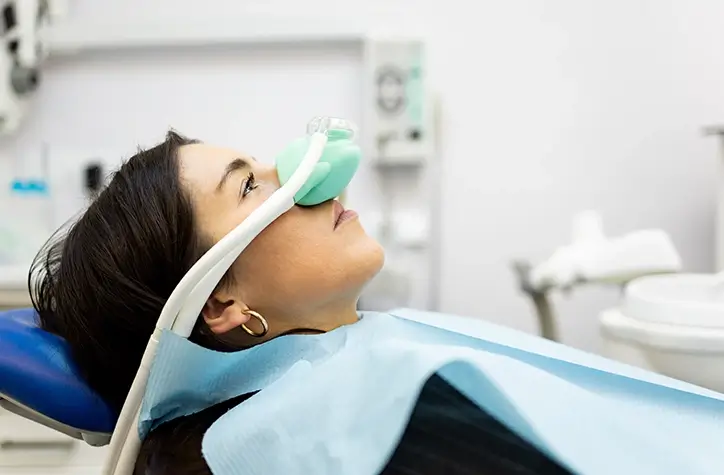
A small, comfortable mask will be placed over your nose. This mask stays in place throughout your procedure, delivering a mixture of nitrous oxide and oxygen that you breathe normally.
Within 2-5 minutes, you’ll begin to feel the effects. Most patients describe a pleasant, warm, tingling sensation that starts in the hands and feet and spreads throughout the body. You’ll feel increasingly relaxed and calm, and many patients report feeling happy or euphoric.
The dental team will check in with you to make sure you’re comfortable. If you need more sedation, the gas concentration can be increased. If you feel too light-headed, it can be decreased.
You remain fully conscious and aware throughout your treatment. You can hear what’s happening around you, you’ll know that dental work is being done, and you can respond to questions or requests. Many patients find that while they’re aware, they simply don’t care very much about what’s happening.
Local anesthetic injections will still be given to numb the treatment area. Many patients find these injections far less bothersome when relaxed on nitrous oxide.
The procedure then continues as it normally would, with you breathing the nitrous oxide mixture the entire time.
Oral Sedation Experience
With oral sedation, you’ve already taken your medication at home, so when you arrive at Holladay Dental Studio, you’re likely already feeling its effects.
As you settle into the dental chair, you’ll probably feel quite drowsy and relaxed. The room might seem slightly surreal or dreamlike. Sounds may seem distant or muffled.
The dental team will position you comfortably and may place monitoring equipment to track your vital signs, though this is less intensive than with IV sedation.
Local anesthetic injections are given to numb the treatment area. Most patients under oral sedation barely notice these injections.
During the procedure itself, you’ll likely drift in and out of light sleep. You might doze off for periods, wake up briefly, and then drift off again. Time loses its usual meaning, and even lengthy procedures often seem to pass in just minutes.
You can still respond if someone speaks to you directly or touches your arm, but you won’t feel motivated to engage in conversation or pay attention to what’s happening. This is exactly what most anxious dental patients want: to be present but detached.
Many patients later report that they remember almost nothing about the procedure itself. They might recall walking into the office and then suddenly being told it’s over.
IV Sedation Process
IV sedation involves a few more steps than other sedation methods:
First, monitoring equipment will be attached. This typically includes a blood pressure cuff on your arm, a pulse oximeter on your finger to measure oxygen levels, and potentially electrodes to monitor your heart rate.
Next comes IV placement. A small needle is used to insert a thin, flexible catheter into a vein in your arm or hand. This is usually the only uncomfortable moment in the entire process, and it lasts just seconds. Once the catheter is in place, the needle is removed, leaving only the soft plastic tube through which medications will be delivered.
The sedation medication is then administered through the IV line. Unlike oral sedation that takes an hour to work, IV sedation takes effect within seconds. You’ll feel relaxation washing over you almost immediately.
As the medication works, you’ll become progressively more sedated. Within a minute or two, you’ll feel profoundly relaxed and drowsy. Your awareness of your surroundings will fade.
Many patients under IV sedation drift between light sleep and a twilight state where they’re not quite asleep but not really awake either. You may occasionally be aware of voices or sensations but in a distant, untroubled way.
Local anesthetic is administered, though you’re unlikely to notice or remember this.
Throughout your procedure, your vital signs are continuously monitored. A team member stays with you the entire time, adjusting sedation levels as needed and ensuring your safety.
Most patients have little to no memory of the actual dental work being performed. The experience feels like closing your eyes for a moment and then suddenly being told everything is finished.
During Your Dental Procedure: What’s Happening
While you’re sedated, Dr. Ericksen and his team work efficiently to complete your necessary dental treatment. The specific procedures vary based on what you need, but certain elements remain consistent:
You’re positioned comfortably throughout your treatment. The dental chair is adjusted to give Dr. Ericksen optimal access to your mouth while supporting your body properly.
Regular breaks are taken during longer procedures, even if you don’t request them. This gives you time to swallow, rest your jaw, and ensure you remain comfortable.
The team communicates with you, especially if you’re under lighter sedation like nitrous oxide. They’ll explain what they’re doing, warn you about louder sounds or unusual sensations, and check in about your comfort level.
Your safety is continuously monitored. With oral and IV sedation, your vital signs are checked regularly. Any concerning changes would prompt immediate appropriate response.
The work is performed to the same high standards whether you’re sedated or not. Sedation makes the experience more comfortable for you but doesn’t change the clinical quality of your care.
Waking Up: The Recovery Process Begins
How you “wake up” from sedation depends largely on which type you received.
Recovery from Nitrous Oxide
Nitrous oxide recovery is the simplest and quickest. Near the end of your procedure, the nitrous oxide will be turned off and you’ll breathe pure oxygen for a few minutes. This helps flush any remaining gas from your system.
Within 5-10 minutes, you’ll feel almost completely back to normal. Any grogginess or light-headedness typically fades very quickly.
You can then sit up, gather your belongings, schedule your next appointment if needed, and drive yourself home. Most patients feel capable of returning to normal activities, including work, immediately after a nitrous oxide appointment.
Recovery from Oral Sedation
Recovery from oral sedation is more gradual. When your dental procedure ends, you’ll be helped to a comfortable position in the dental chair or moved to a recovery area.
You’ll likely feel quite sleepy and uncoordinated. Standing up might make you dizzy. The dental team will help ensure you’re stable before allowing you to move around.
Your driver will be contacted if they’re not already in the office. The team will go over post-procedure instructions with both you and your driver, though you may not remember this conversation clearly.
You’ll be helped to your driver’s vehicle. Some patients need a wheelchair or significant support to walk safely.
Once home, you should plan to rest for the remainder of the day. Most patients sleep for several hours. Even after waking, you’ll likely feel drowsy and slightly confused for the rest of the day and possibly into the evening.
Full recovery typically takes 24 hours. By the next day, most patients feel back to normal.
Recovery from IV Sedation
IV sedation recovery is most intensive. When your procedure concludes, the sedation medication will be discontinued. If you’re very deeply sedated, medications can be given to reverse the effects more quickly.
You’ll spend time in a recovery area, resting comfortably while the sedation wears off. During this period, you’ll be monitored to ensure your vital signs remain stable and you’re waking up appropriately.
Initially, you may be very sleepy and have difficulty keeping your eyes open or following conversations. This is normal. Over 30-60 minutes, you’ll gradually become more alert.
Before you’re allowed to leave, you must demonstrate that you’re stable: able to sit up without dizziness, able to walk with assistance, and reasonably alert (though you’ll still be impaired).
Your driver will receive detailed post-procedure instructions, including signs of complications to watch for, though serious complications are rare.
The ride home should be comfortable. Many patients doze in the car.
Once home, plan to spend the rest of the day resting. You’ll likely sleep for several hours. When you wake, you’ll still feel drowsy and may have difficulty with coordination or clear thinking.
Full recovery from IV sedation can take 24-48 hours. Most patients feel significantly better by the next day but may still feel slightly “off” or more tired than usual.
Post-Sedation Care: Taking Care of Yourself
After sedation dentistry, following proper post-procedure care instructions ensures your comfort and recovery.
Immediate Aftercare (First 24 Hours)
Rest is essential. Don’t fight drowsiness. Your body needs time to fully metabolize the sedation medications. Plan to spend the day resting at home.
Avoid driving or operating machinery. Even if you feel okay, your reaction time and judgment remain impaired. Don’t drive, use power tools, cook with sharp knives or hot stoves, or engage in any activity requiring full alertness.
Don’t make important decisions. Your judgment is affected for at least 24 hours after oral or IV sedation. Don’t sign contracts, make major purchases, or decide on important matters.
Stay hydrated. Sip water or other clear fluids to help flush medications from your system. Avoid alcohol completely.
Eat lightly. Start with bland, soft foods like broth, yogurt, applesauce, or crackers. Your stomach may be sensitive, and you need to be careful with your mouth if you’ve had dental work done.
Take prescribed medications as directed. Dr. Ericksen may prescribe pain relievers or antibiotics. Follow instructions carefully.
Have someone stay with you. Especially after oral or IV sedation, you shouldn’t be alone for at least several hours. You may feel confused or unsteady and could potentially fall or injure yourself.
Managing Your Mouth After Dental Work
Remember, you’ve not only been sedated but also had dental procedures performed. Your mouth needs care:
Keep gauze in place over extraction sites or surgical areas as instructed, typically 30-60 minutes.
Avoid disturbing the treatment area with your tongue.
Don’t rinse vigorously or drink through a straw for at least 24 hours, as this can dislodge blood clots and cause complications.
Expect some numbness in your mouth from the local anesthetic for several hours after your sedation wears off. Be careful not to bite your cheeks or tongue while numb.
Apply ice packs as recommended to reduce swelling.
Follow all specific post-operative instructions provided by Dr. Ericksen.
When to Contact the Office
While complications after sedation dentistry are rare, know when to call Holladay Dental Studio:
If you experience severe or worsening pain not controlled by prescribed medications. If you develop a fever above 101°F. If you have excessive bleeding that doesn’t slow after applying pressure. If you experience significant swelling, especially if it worsens after 48 hours. If you have difficulty breathing or swallowing. If you have persistent nausea or vomiting. If you have any other symptoms that concern you.
The team at Holladay Dental Studio is available to address concerns and provide guidance throughout your recovery.
What Patients Say About Their Experience
Many patients who were initially nervous about trying sedation dentistry report being surprised by how comfortable and straightforward the experience actually was.
Common positive feedback includes relief at how quickly time passed, surprise at feeling so relaxed during treatment they thought would be terrifying, appreciation for having little to no memory of the procedure, and gratitude for finally being able to address dental problems they’d avoided for years.
Some patients note that their expectations (often based on anxiety) were worse than the reality. The anticipation of sedation can feel more daunting than the actual experience.
Building Confidence for Future Appointments
Many patients find that successfully completing one sedated appointment makes future dental visits significantly less stressful. You now know what to expect, you have evidence that the process works for you, and you’ve proven to yourself that you can handle dental care.
Some patients discover that after a few appointments with sedation, their anxiety decreases enough that they become comfortable with less sedation or even no sedation for routine procedures. Others continue to choose sedation for every appointment, and that’s perfectly fine. There’s no pressure to “graduate” from sedation if you continue to benefit from it.
Preparing for Your Next Sedation Appointment
If you’re ready to schedule a sedated appointment at Holladay Dental Studio, here’s what to do:
Call 801-277-9213 to discuss your needs and schedule your procedure.
Ask any remaining questions you have about the sedation process. The team is happy to address every concern.
Mark your calendar with your appointment date and any preparation deadlines (like when to start fasting for IV sedation).
Arrange transportation and care support if needed for oral or IV sedation.
Follow all pre-appointment instructions carefully.
Try to relax and trust the process. You’re making a great choice for your oral health.
For more information about whether sedation dentistry might be right for you, explore our guide on who needs sedation dentistry.
Your Comfort Is Our Priority
At Holladay Dental Studio, serving Holladay, Salt Lake City, Cottonwood Heights, Millcreek, and Murray, Dr. Andrew Ericksen and his team understand that knowing what to expect makes sedation dentistry far less intimidating. Every step of the process is designed with your comfort, safety, and peace of mind in focus.
Whether you choose nitrous oxide for gentle relaxation, oral sedation for deeper calm, or IV sedation for maximum comfort, you can feel confident that you’re in experienced, caring hands.
Don’t let uncertainty about the sedation process prevent you from getting the dental care you need. With proper preparation and understanding of what to expect, sedation dentistry can transform your dental experience from something you dread into something manageable and even comfortable.Ready to take the next step? Contact Holladay Dental Studio today at 801-277-9213 to discuss your sedation options and schedule your appointment. Your journey to anxiety-free dental care starts here.